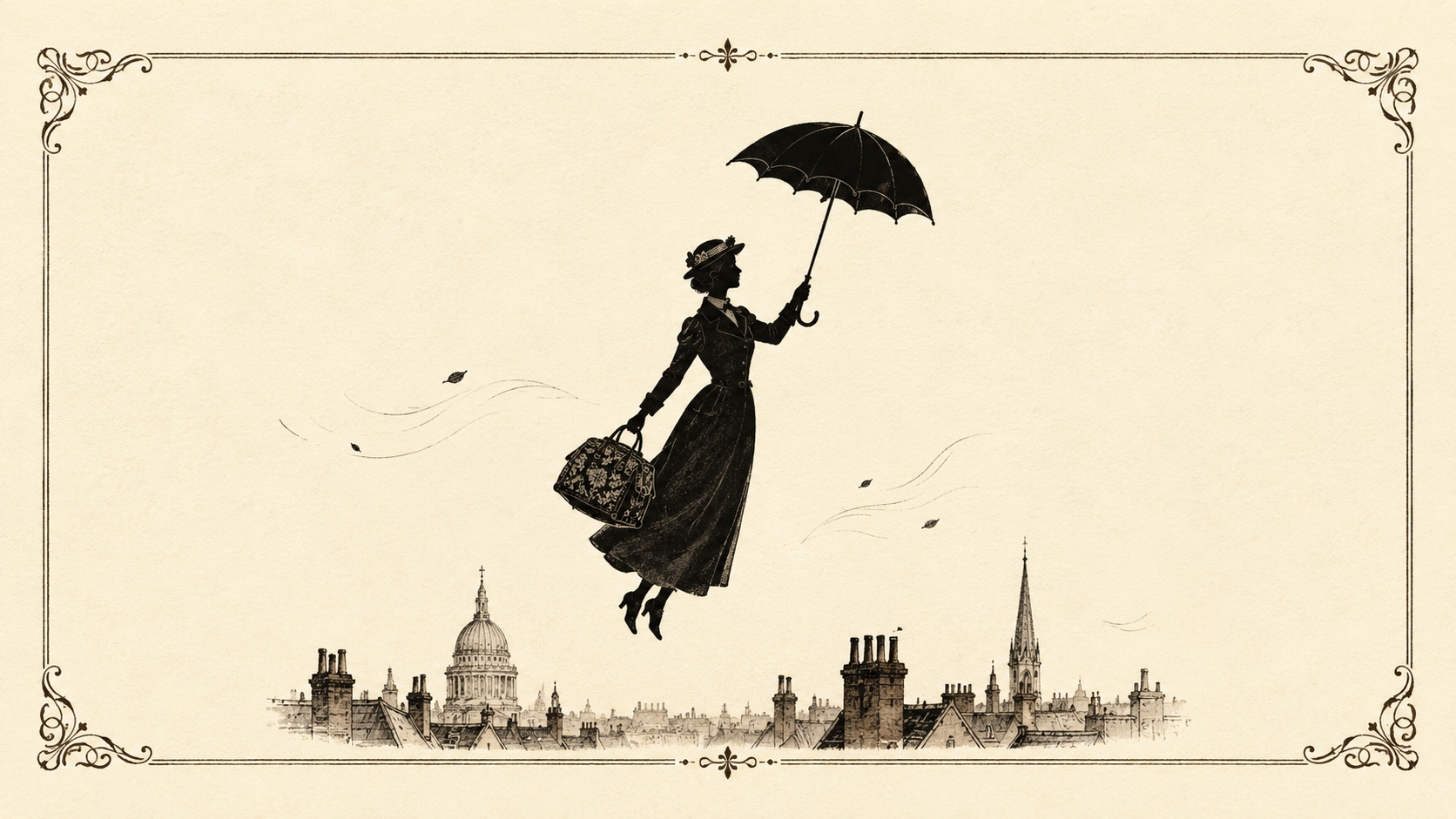
The Secret of Mary Poppins
Clue: It's about Love
By Benjamin David Wolaver
The Secret of Mary Poppins
When I was five years old, I broke the videotape of Mary Poppins. Not through childhood negligence, but because I watched it so often that the player ate the tape. Why did I love the film so much? I thought the answer was obvious: great music, comedy, whimsy—all things I loved as a boy. But there’s more to Mary Poppins than meets the eye, and I didn’t realize it until I grew up and saw it again after many years.
As the lead actor in a Christian children’s show, The Wonderful World of Benjamin Cello, which is deeply inspired by the Julie Andrews classic, I’ve always found my early love of the story a bit ironic—perhaps I had some of Burt the chimneysweep in my DNA. The character I play owes a great deal to Dick Van Dyke’s whimsical artist: a country gentleman named Benjamin Cello who, like Burt, breaks into song and dance, plays an instrument, and steps through magical doors. Our desire in creating Benjamin Cello was to resurrect that whimsical, artistic spirit (complete with puppetry and live music), but with a “healthy helping” (as Burt might say) of Scripture and faith.
But it wasn’t until I sat down with my children to watch the old classic that I realized how deeply I had misunderstood the story.
Perhaps you remember the plot: two neglected children, a checked-out mother, a legalistic father, and a “practically perfect” nanny who makes everyone realize that life is more than bank accounts and ledgers.
Viewed this way, you might think of Poppins the way actor David Tomlinson did (he played Mr. Banks): “I thought it was the worst film I had ever seen, the most sentimental rubbish.” Indeed, what is one to make of a story that celebrates throwing away money on bird seed? Despite her severe demeanor, Mary Poppins can seem like a kind of subversive proto-hippie.
But I saw something different when I revisited the film as an adult. Here is a family coming apart at the seams, a family in desperate need of heavenly intervention. And then the wind changes—a sign of grace. This wind blows away all the “normal nannies,” a symbol of a purifying truth that supplants mere imitation. And then the true, virginal mother descends: Mary, a woman who is clearly more angel than sorceress.
Once she has secured the position, she begins a series of lessons. The children learn that a “spoonful of sugar” helps them endure suffering. Just what this “spoonful of sugar” is remains unclear at first. Then she teaches them a new word: “supercalifragilisticexpialidocious.” What does this word mean? It seems to be an ultimate superlative, as undefined as the “spoonful of sugar.” But then the lyrics disclose a humorous anecdote:
One night I said it to me girl
And now me girl’s me wife
Now we see more clearly: supercalifragilisticexpialidocious is a superlative—a superlative for the ultimate reality: Love. Love is the “spoonful of sugar” that can make any job, any difficulty, easy to bear.